
The stock market in India is a regulated marketplace where people buy and sell shares of listed companies through a broker, on one of two major exchanges: the National Stock Exchange (NSE) or the Bombay Stock Exchange (BSE). Prices move every second based on supply and demand. Once you buy, the shares land in your demat account within one working day.
That is the short answer. But if you have ever opened a trading app, watched the Nifty turn red, and wondered what is actually happening behind the screen, this guide is for you.
Below, we break down how the stock market works in India step by step: who the players are, what happens when you tap “Buy,” what makes prices rise and fall, and what it costs to participate. No jargon walls, no hype. Just the mechanics, explained the way a friend who works in finance would explain them over chai.
Note: This article is for education only. It is not investment advice. Talk to a SEBI-registered investment adviser before making decisions with your money.
What Is the Stock Market, Really?
A stock (or share) is a small slice of ownership in a company. If a company has 10 crore shares and you own 1,000 of them, you own a tiny fraction of that business. You share in its growth through rising share prices and, sometimes, dividends.
The stock market is simply the system that lets those slices change hands. It works in two stages.
The primary market: where shares are born
When a company wants to raise money from the public for the first time, it launches an Initial Public Offering (IPO). Investors apply for shares, the company receives the money, and the shares get listed on an exchange.
This is the primary market. Money flows directly from investors to the company. Think of it as buying a new car straight from the manufacturer.
The secondary market: where shares are traded
After listing, the company steps out of the picture. Investors now trade those shares with each other on the NSE or BSE. When you buy 10 shares of a listed bank on your trading app, you are buying them from another investor, not from the bank itself.
This is the secondary market, and it is what most people mean when they talk about “the share market.” To extend the analogy, it is the used-car market. The car already exists; only the owner changes.
Understanding this split clears up a common confusion. A falling share price does not directly take money out of the company’s bank account. It reflects what investors are willing to pay for ownership today.
Stock Exchanges in India: NSE and BSE
A stock exchange is the official, electronic marketplace where buy and sell orders meet. India has two main ones, and most large companies list on both.
| BSE (Bombay Stock Exchange) | NSE (National Stock Exchange) | |
|---|---|---|
| Founded | 1875, Asia’s oldest exchange | 1992, began trading in 1994 |
| Location | Dalal Street, Mumbai | Bandra Kurla Complex, Mumbai |
| Benchmark index | Sensex (30 large companies) | Nifty 50 (50 large companies) |
| Known for | Huge number of listed companies, including many small ones | Higher trading volumes, especially in futures and options |
NSE was the first in India to offer fully screen-based electronic trading, which ended the era of brokers shouting orders on a trading floor. Today, both exchanges are fully electronic and match orders in fractions of a second.
What are Sensex and Nifty?
You will hear “the market is up 300 points” on the news. That usually refers to the Sensex or the Nifty 50.
An index is a basket of selected stocks that represents the broader market. The Sensex tracks 30 large, well-established companies on the BSE. The Nifty 50 tracks 50 on the NSE. When most of these big companies rise, the index rises, and people say the market had a good day.
There are also sector indices (Nifty Bank, Nifty IT, Nifty Pharma) and size-based ones (Nifty Midcap 150, BSE Smallcap). They help you see which parts of the economy are doing well.
Can you buy a stock on NSE and sell it on BSE? For delivery trades, generally yes, because the shares sit in your demat account, not with the exchange. Your broker handles the routing.
The Key Players Behind Every Trade
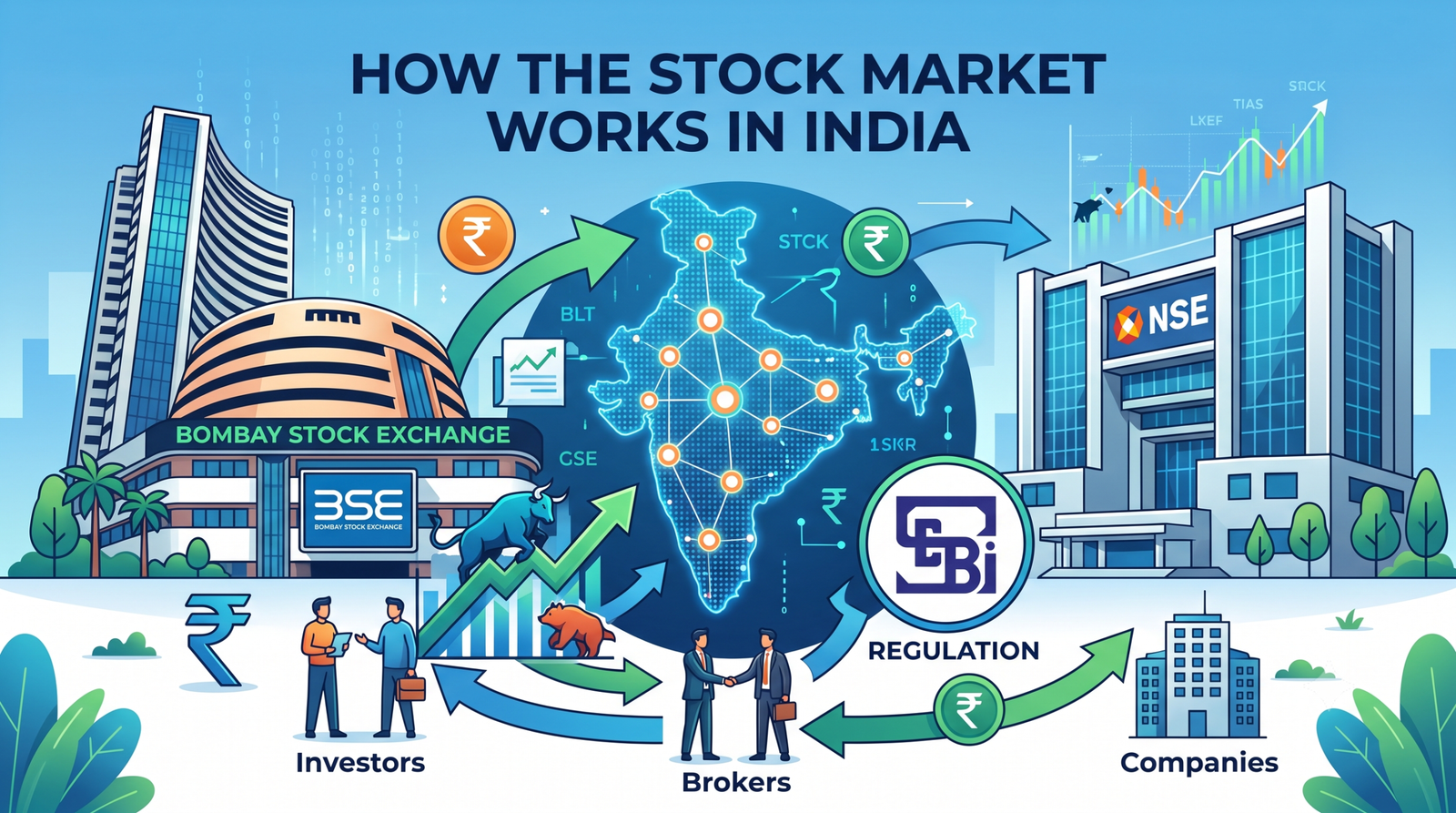
A single share purchase passes through several hands. Each one has a clear job, and together they make the system safe enough for millions of retail investors.
SEBI (Securities and Exchange Board of India). SEBI is the market regulator. It writes the rules, registers brokers and advisers, monitors insider trading and price manipulation, and protects investors. If an exchange is the playing field, SEBI is the referee.
Stock exchanges (NSE and BSE). They run the trading platforms, list companies, and make sure listed firms disclose results and major events on time.
Stockbrokers. You cannot place orders on an exchange directly. A SEBI-registered broker (Zerodha, Groww, ICICI Direct, Upstox and many others) gives you a trading account and app, and sends your orders to the exchange.
Depositories (NSDL and CDSL). Shares in India are held electronically, not as paper certificates. Two depositories, NSDL and CDSL, keep these records. Your broker acts as a Depository Participant (DP) and opens a demat account for you with one of them.
Clearing corporations. NSE Clearing (for NSE) and Indian Clearing Corporation (for BSE) sit in the middle of every trade. They guarantee settlement, so if the person on the other side defaults, you still get your shares or your money.
Investors. Retail investors like you, plus mutual funds, insurance companies, foreign portfolio investors (FPIs) and domestic institutions. Big institutional flows often move the market more than anything else in the short term.
How a Trade Works, Step by Step
Let’s follow a real-world style example. Priya wants to buy 20 shares of a large IT company trading at around ₹1,500. Here is what happens.
- She places an order. On her broker’s app, Priya chooses the stock, the quantity, and the order type. A market order buys at the best available price right now. A limit order buys only at ₹1,500 or lower.
- The broker runs checks. The app confirms she has enough funds (about ₹30,000 plus charges) and that the order follows exchange rules. Then it sends the order to the exchange.
- The exchange matches it. The exchange keeps an order book, a live list of every pending buy and sell order for that stock. Its matching engine pairs Priya’s buy with a seller’s order at a compatible price, giving priority to the best price and then to whoever came first.
- She gets a confirmation. Within seconds, the trade is executed. By evening, her broker sends a contract note showing the price, quantity and all charges.
- The clearing corporation settles it. The clearing corporation works out who owes what, collects money from buyers and shares from sellers, and guarantees the trade.
- Shares reach her demat account. India follows a T+1 settlement cycle. If Priya buys on Monday (T), the shares are credited to her demat account on Tuesday (T+1). The seller receives the money on the same day.
India moved fully to T+1 in January 2023, making it one of the fastest settlement systems among major markets. SEBI has since added an optional same-day (T+0) settlement for a limited set of stocks, though T+1 remains the standard for most trades.
Delivery vs intraday trading
What Priya did is a delivery trade: she buys and holds the shares for as long as she likes. In intraday trading, a trader buys and sells the same stock within one day, so no shares ever reach the demat account. Intraday is far riskier and is better left alone until you understand the market well.
What Makes Share Prices Go Up and Down?
At the most basic level, how the share market works comes down to supply and demand. If more people want to buy a stock than sell it, buyers bid higher and the price rises. If sellers outnumber buyers, the price falls.
The harder question is why demand changes. A few forces do most of the work:
- Company performance. Quarterly results, profit growth, new contracts, management changes and debt levels all shape what investors think a business is worth.
- Economic data. Interest rate decisions by the Reserve Bank of India, inflation, GDP growth and the Union Budget affect entire sectors at once.
- Institutional money. When foreign investors pull money out of India, large stocks can fall even if nothing changed at the companies. Steady monthly SIP inflows into mutual funds have become a strong counterweight in recent years.
- Global events. US interest rates, crude oil prices, the rupee-dollar rate and geopolitical tensions ripple into Indian markets quickly.
- Sentiment. Fear and greed are real. News headlines, social media buzz and herd behaviour can push prices far from fair value in the short run.
Over short periods, sentiment often wins. Over many years, share prices tend to follow a company’s earnings. That is why long-term investors focus on business quality, not daily price swings.
Circuit limits: India’s safety brakes
To stop panic from spiralling, exchanges use circuit limits. Many individual stocks have price bands (for example 5%, 10% or 20%) that cap how far they can move in a day. There are also market-wide circuit breakers: if the Sensex or Nifty falls 10%, 15% or 20%, trading across the market halts for a set time. These rules give investors a moment to breathe before acting.
Trading Hours, Costs and Taxes
When the market is open
The equity market on NSE and BSE runs Monday to Friday, except exchange holidays.
| Session | Time (IST) |
|---|---|
| Pre-open session | 9:00 am to 9:15 am |
| Normal trading | 9:15 am to 3:30 pm |
| Closing session | 3:40 pm to 4:00 pm |
The pre-open window helps the exchange discover a fair opening price after overnight news. Exchanges also hold a special one-hour Muhurat trading session on Diwali, a tradition many investors follow for good luck.
What a trade really costs
The price on the screen is not the full cost. Every trade carries a few charges, shown on your contract note:
- Brokerage: Discount brokers often charge zero on delivery trades and a small flat fee on intraday. Full-service brokers usually charge a percentage.
- Securities Transaction Tax (STT): A government tax on buying and selling shares.
- Exchange and SEBI fees: Small transaction charges.
- Stamp duty: Charged on the buy side.
- GST: 18% on brokerage and transaction charges.
- DP charge: A flat fee each time you sell shares from your demat account.
For a long-term investor, these add up to a small fraction of a percent per trade. For someone trading many times a day, they can eat a large part of the profit.
How profits are taxed
Gains from listed shares are taxed based on how long you hold them. Under the rules introduced in the July 2024 Union Budget, gains on shares sold within 12 months (short-term) are taxed at 20%. Gains on shares held longer than 12 months (long-term) are taxed at 12.5% on the portion above ₹1.25 lakh in a financial year. Dividends are added to your income and taxed at your slab rate.
Tax rules change, so confirm current rates with a chartered accountant or the Income Tax Department before filing.
How to Start Investing in the Indian Stock Market
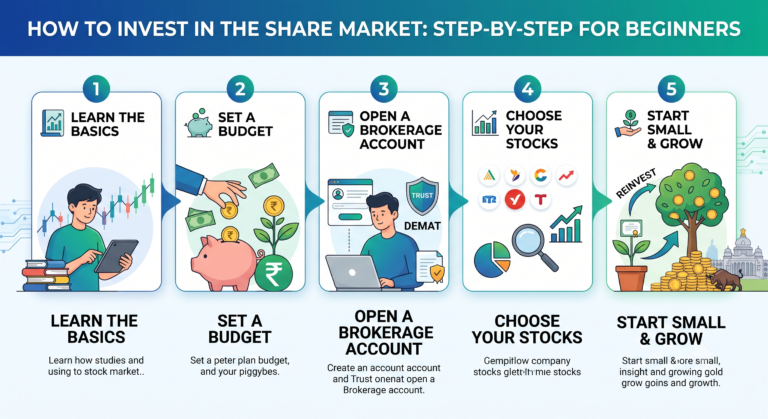
Getting in is easier than ever. Most people finish the whole process on their phone in a day or two.
- Keep your documents ready. You need a PAN card, Aadhaar (linked to your mobile number for e-KYC), a bank account and a cancelled cheque or bank statement.
- Pick a SEBI-registered broker. Compare brokerage charges, app quality, research tools and customer support. You can verify any broker’s registration on SEBI’s website.
- Open a demat and trading account. Most brokers open both together. The demat account holds your shares; the trading account places your orders.
- Add funds. Transfer money from your linked bank account through UPI or net banking.
- Start small and learn. Buy a few shares of companies you understand, or begin with a Nifty 50 index fund to get broad market exposure without picking stocks.
Common beginner mistakes to avoid
- Acting on tips. Stock tips from WhatsApp groups, Telegram channels or social media “finfluencers” are a common route to losses, and some are outright pump-and-dump schemes.
- Jumping into futures and options early. SEBI’s own studies have found that a large majority of individual F&O traders lose money. Learn the cash market first.
- Putting all your money in one stock. Spread your money across companies and sectors so one bad bet does not sink your portfolio.
- Checking prices every hour. Constant watching leads to emotional decisions. Set a review schedule, such as once a quarter.
- Investing money you need soon. Money for rent, fees or emergencies belongs in safer places. Equity is best for goals at least five years away.
Key Takeaways
- The stock market in India lets you buy and sell ownership in listed companies through a SEBI-registered broker.
- Companies raise money in the primary market (IPOs); investors trade with each other in the secondary market.
- NSE and BSE are India’s main stock exchanges. The Nifty 50 and Sensex track the overall mood of the market.
- Trades settle on T+1, and shares are held electronically in your demat account through NSDL or CDSL.
- Prices follow supply and demand in the short run and company earnings in the long run.
Frequently Asked Questions
How does the stock market work in India for beginners?
A. You open a demat and trading account with a SEBI-registered broker, add money, and place buy or sell orders through the broker’s app. The exchange matches your order with another investor’s, and the shares reach your demat account the next working day.
What is the difference between the share market and the stock market?
A. In everyday Indian usage, they mean the same thing. Both refer to the system where shares of listed companies are bought and sold on exchanges like NSE and BSE.
How much money do I need to start?
A. There is no fixed minimum. You can buy a single share, so the starting amount is the price of one share plus small charges. Some index funds and SIPs start from a few hundred rupees.
Is the Indian stock market safe?
A. The system is well regulated. SEBI oversees the market, clearing corporations guarantee trades, and your shares are held in your own name with a depository. However, share prices themselves can fall sharply, so the investment carries market risk.
Which is better, NSE or BSE?
A. For most retail investors, it makes little practical difference. Prices for large stocks are nearly identical on both. NSE usually has higher trading volumes, which can mean slightly better prices on actively traded stocks.
Final Thoughts
Once you see the moving parts, how the stock market works stops feeling mysterious. You place an order, the exchange finds a match, the clearing corporation guarantees it, and the shares land in your demat account a day later. SEBI watches over all of it.
The mechanics are the easy part. The real skill is patience: buying good businesses, holding them through noisy markets, and keeping costs low. Start small, keep learning, and let time do the heavy lifting.