
The stock market in India is where companies sell shares and investors buy and sell them. Most of it happens on two exchanges, the NSE and the BSE, and the regulator SEBI oversees all of it. To start, you need a PAN card, a bank account and a demat account with a registered broker. You can buy your first share the same day your account goes live.
More Indians invest now than ever before. In mid-2026, NSE’s unique trading accounts passed 26 crore, and the exchange had more than 13 crore unique registered investors. Many of them are first-time investors from smaller cities. That growth also means a lot of people are learning the hard way, so this guide covers both how the market works and where beginners usually go wrong.
How the Indian Stock Market Works
When a company wants to raise money from the public, it lists on a stock exchange through an IPO (Initial Public Offering). Once it’s listed, its shares trade every working day. Investors buy and sell through a broker, and the price moves with supply and demand.
Four kinds of institutions keep the system running:
- Stock exchanges (NSE and BSE) match buy and sell orders.
- SEBI (Securities and Exchange Board of India) writes the rules and protects investors.
- Depositories (NSDL and CDSL) hold your shares electronically, much like a bank holds your money.
- Brokers give you the app or platform to place orders. They must be registered with SEBI.
India uses T+1 settlement. If you buy a share on Monday, it lands in your demat account on Tuesday. If you sell, the money reaches your trading account the next working day.
NSE vs BSE: What’s the Difference?
The Bombay Stock Exchange (BSE), set up in 1875, is Asia’s oldest stock exchange. Its main index is the Sensex, which tracks 30 large companies.
The National Stock Exchange (NSE) began trading in 1994 and handles most of India’s trading volume today, especially in derivatives. Its main index is the Nifty 50, which tracks 50 large companies across sectors.
Most large companies are listed on both, and your broker usually picks the exchange for you. As a beginner, you don’t need to worry much about the choice.
What Sensex and Nifty Tell You
When news reports say “the market fell today,” they usually mean the Sensex or Nifty went down. These indices work like a thermometer for the broader market. If the Nifty 50 rises 1%, the country’s biggest companies, on average, gained value that day.
There are other indices too, such as Nifty Bank, Nifty IT, Nifty Midcap 150 and Nifty Smallcap 250. They help you see how particular sectors or company sizes are doing.
Market Timings
Indian stock exchanges are open Monday to Friday, except on exchange holidays.
| Session | Time (IST) |
|---|---|
| Pre-open session | 9:00 am to 9:15 am |
| Normal trading | 9:15 am to 3:30 pm |
| Closing session | 3:40 pm to 4:00 pm |
NSE and BSE publish the list of trading holidays at the start of each year.
What Can You Invest In?
Shares get most of the attention, but the market offers much more:
Equity shares make you a part-owner of a company. You gain if the share price rises and may receive dividends.
Mutual funds pool money from many investors and a professional fund manager invests it. Most people invest through a SIP (Systematic Investment Plan), putting in a fixed amount every month.
ETFs (Exchange Traded Funds) trade like shares but hold a basket of stocks. For example, a Nifty 50 ETF tracks the index. They’re cheap and simple, which makes them a good place for beginners to start.
Bonds and government securities pay fixed interest. They carry less risk than stocks and usually earn less.
Derivatives (Futures and Options) are contracts based on the price of a stock or index. They’re high-risk tools, and most beginners should stay away from them (more on this below).
How to Start Investing in the Stock Market
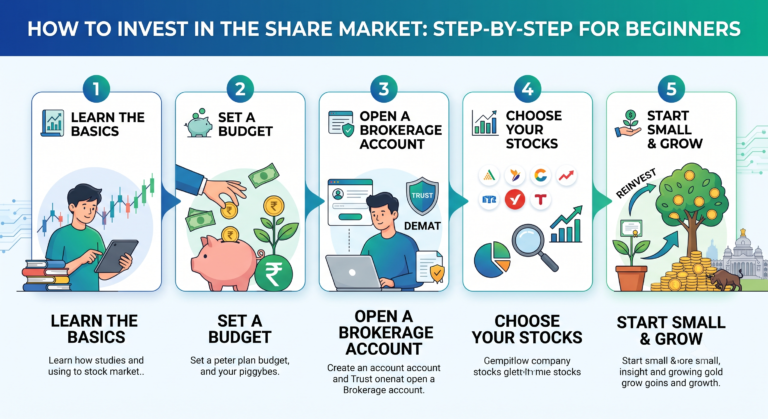
- Get your documents ready. You need a PAN card, Aadhaar (linked to your mobile number for e-KYC), a bank account and a cancelled cheque or bank statement.
- Choose a SEBI-registered broker. Compare brokerage charges, how easy the app is to use, customer support and account maintenance fees. You can check whether a broker is registered on SEBI’s website.
- Open a demat and trading account. With most brokers the process is fully online and takes a day or two.
- Add money to your trading account from your linked bank account.
- Start small. Buy one index fund, ETF or large, well-known company before you try anything more complex.
A useful rule: only invest money you won’t need for at least three to five years. Stock prices can fall sharply over short periods, and you don’t want to be forced to sell at a loss.
Investing vs Trading
Beginners often mix these up, and the difference matters.
Investing means buying good businesses or funds and holding them for years. Your returns come from the companies growing over time.
Trading means buying and selling over days, hours or even minutes to profit from price swings. It takes time, discipline and risk control, and the odds are against most people.
SEBI’s own research shows this. In its study of equity F&O released in August 2026, about 87.7% of individual traders lost money in FY26. Their combined net loss was around ₹91,685 crore. An earlier SEBI study found 93% of individual F&O traders made losses between FY22 and FY24. If a friend or a Telegram group promises easy option trading profits, remember these numbers.
How Stock Market Gains Are Taxed in India
For listed shares and equity mutual funds (FY 2026-27):
| Type of gain | Holding period | Tax rate |
|---|---|---|
| Short-term capital gains (STCG) | 12 months or less | 20% |
| Long-term capital gains (LTCG) | More than 12 months | 12.5% on gains above ₹1.25 lakh a year |
Dividends are added to your income and taxed at your slab rate. Profits from intraday trading and F&O count as business income, which has its own rules. Budget 2026 didn’t change the headline equity rates, but tax rules do change, so check with a chartered accountant before you file.
Common Mistakes Beginners Make
Following tips blindly. WhatsApp forwards, social media “gurus” and unregistered advisers are behind a lot of retail losses. SEBI has cracked down on unregistered investment advisers, so check whether someone is registered before you trust their advice.
Putting everything in one stock. Even strong companies can have a bad year. Spreading your money across sectors, or simply using an index fund, lowers that risk.
Panic selling during a fall. Markets drop from time to time, sometimes by 10% or more. Investors who sold in panic during past crashes often missed the recovery that came after.
Chasing recent winners. A stock that doubled last year is not guaranteed to double again. Look at the business, not just the price chart.
Ignoring costs. Brokerage, STT, GST, stamp duty and DP charges add up quickly if you trade often. Your broker’s contract note shows exactly what you paid.
How SEBI Protects Investors
SEBI requires brokers to keep client money separate, to send you trade confirmations by email and SMS, and to report your holdings through the depositories. Every month, NSDL or CDSL sends you a Consolidated Account Statement (CAS). It lists everything you own, so you can check it against what your broker shows.
If you have a complaint against a broker or listed company, you can file it on SEBI SCORES, the regulator’s online grievance portal. There’s also the SMART ODR platform for online dispute resolution.
Frequently Asked Questions
How much money do I need to start investing in the stock market in India?
There’s no minimum. Some shares cost less than ₹100, and many mutual fund SIPs start at ₹100 to ₹500 a month.
Is the stock market safe for beginners?
The system is well regulated, but share prices can still fall. Diversified, long-term investing through index funds or mutual funds is the lower-risk way to begin.
Can I invest without a demat account?
You can invest in mutual funds without one. To buy shares or ETFs directly, you need a demat account.
What is the difference between a demat and a trading account?
A demat account holds your shares. A trading account is what you use to buy and sell them. Most brokers open both together.
Are Sensex and Nifty the same?
No. The Sensex tracks 30 companies on the BSE and the Nifty 50 tracks 50 companies on the NSE. They usually move in the same direction because they share many of the same large companies.
Final Thoughts
The Indian stock market has never been easier to join. Accounts open online, settlement is quick and costs are low. The hard part is behaving well once you’re in. Start with diversified, low-cost options, invest regularly, ignore the noise and give your money years, not weeks. That approach won’t make headlines, but it’s how most long-term investors actually build wealth.
This article is for educational purposes only and isn’t financial or tax advice. Talk to a SEBI-registered investment adviser or a chartered accountant about your own situation.