

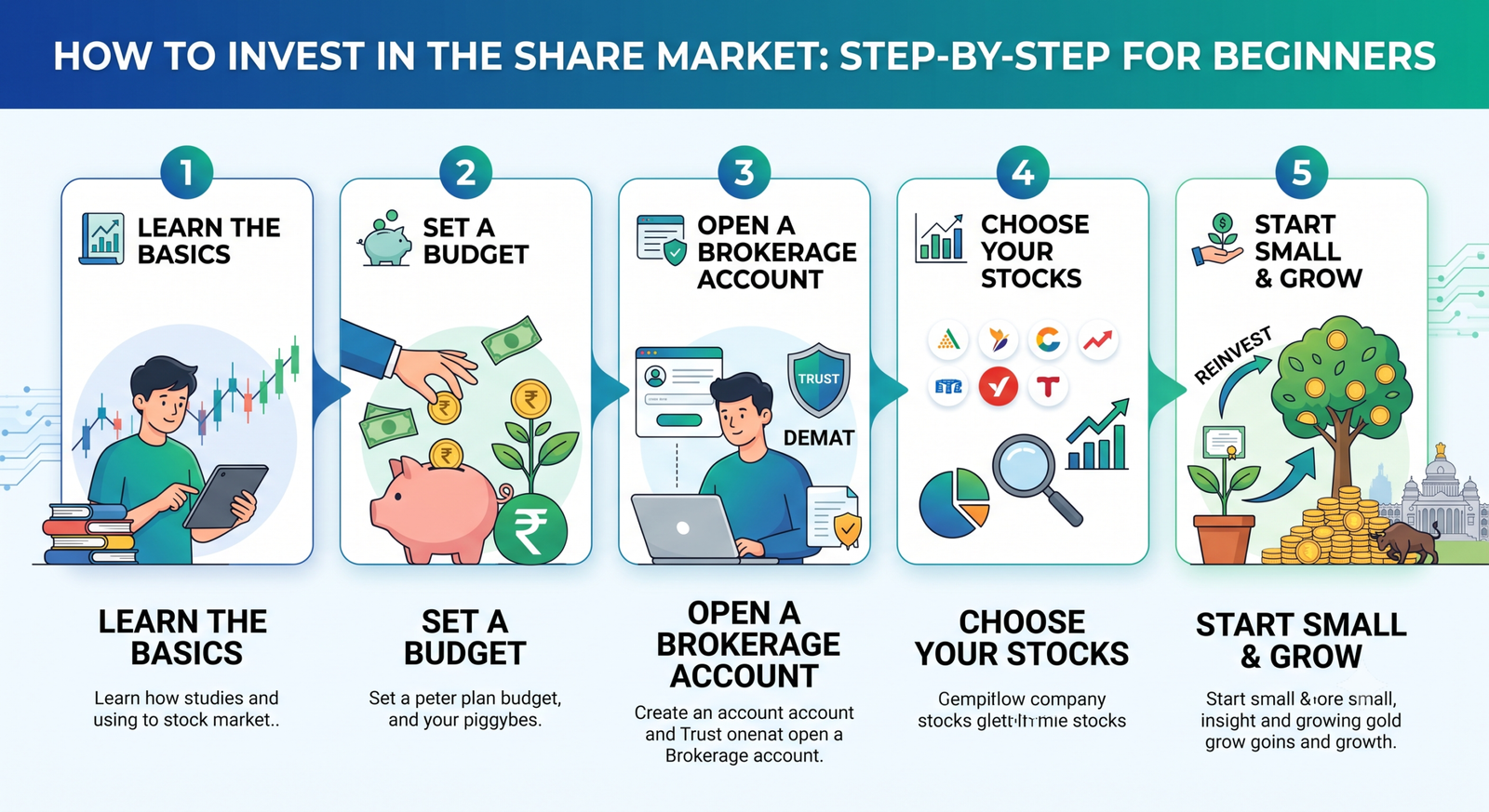
To invest in the share market in India, you need three things: a PAN card, a bank account, and a demat plus trading account with a SEBI-registered broker. Once your KYC is approved (often within a day), you can buy your first share from a mobile app. You can start with as little as 1000 rupees
That is the whole process in one paragraph. The harder part is not opening the account. It is knowing what to buy, how much to put in, and how to avoid the mistakes that make most beginners quit in their first year.
This guide walks you through how to start investing in stocks step by step, from getting your money ready to placing your first order. We will also show you exactly what you can do if you only want to invest with 1000 rupees to begin.
Quick note: This article is for education, not personal financial advice. Stock prices go up and down, and you can lose money. If you are unsure, speak to a SEBI-registered investment adviser.
Before you invest: get these basics right
Most beginners jump straight to picking stocks. A better first step is making sure your finances can handle the ups and downs of the market.
Build a small safety net first
Keep three to six months of expenses in a savings account or liquid fund before you put money into shares. Here is why. If you lose your job or face a medical bill, you do not want to sell your stocks during a market fall just to pay rent. An emergency fund lets your investments stay invested.
If you have high-interest debt, like a credit card balance at 36% or more a year, pay that off first. No stock reliably beats that kind of interest.
Decide why you are investing
Your goal shapes everything else. Money you need in one year for a wedding or a car should not be in stocks at all. Money for retirement in 20 years can handle short-term drops because it has time to recover.
A simple rule many investors use: only put money into shares that you will not need for at least five years.
Understand a few key terms
You do not need to learn finance jargon, but these terms will come up in your first week:
- Share (or stock): A small piece of ownership in a company.
- Sensex and Nifty 50: Indexes that track the biggest companies on the BSE and NSE. People use them to judge how “the market” is doing.
- Demat account: Holds your shares in electronic form, like a bank account for stocks.
- Trading account: Lets you place buy and sell orders.
- Index fund or ETF: A fund that buys all the stocks in an index, so you own a slice of many companies at once.
- SIP: A Systematic Investment Plan, where a fixed amount is invested automatically every month.
How to invest in share market: 7 steps for beginners
Step 1: Keep your documents ready
You will need a PAN card, an Aadhaar card linked to your mobile number, a bank account in your name, and a cancelled cheque or recent bank statement. Most brokers also ask for a photo and a signature, which you can upload from your phone.
Step 2: Choose a SEBI-registered broker
A broker is the company whose app or website you use to buy and sell shares. India has two main types.
| Broker type | Best for | What to expect |
|---|---|---|
| Discount broker | Self-directed beginners | Low or zero brokerage on delivery trades, simple apps, little hand-holding |
| Full-service broker | Investors who want research and advice | Higher fees, research reports, a relationship manager |
Before you sign up, check a few things. Confirm the broker is registered on the SEBI website. Look at the annual demat maintenance charge (AMC), brokerage on delivery trades, and how easy the app feels to use. Read the fee page, not just the ads.
Step 3: Open your demat and trading account
Most brokers open both accounts together through one online form. You fill in your details, upload documents, and complete e-KYC with an Aadhaar OTP and a short video or selfie check. Approval usually takes anywhere from a few hours to two working days.
Step 4: Add money to your trading account
Transfer funds from your linked bank account using UPI or net banking. Start small. There is no rule that says you must invest a large amount on day one.
Step 5: Pick what to buy
This is where beginners feel stuck. You have two broad paths.
Path A: Index funds or ETFs. A Nifty 50 index fund or ETF gives you a small stake in 50 of India’s largest companies in one purchase. You do not need to research individual businesses, and your risk is spread out. For most first-time investors, this is the easiest place to start.
Path B: Individual stocks. If you want to pick companies, start with businesses you already understand. Maybe you use their products every day. Then look at a few basics: Is revenue growing over the last five years? Is the company profitable? Does it carry a lot of debt? Avoid buying a stock just because it was trending on social media or in a WhatsApp group.
Many investors do both. They put most of their money in an index fund and use a small portion to learn by picking a few stocks.
Step 6: Place your first order
Search for the stock or ETF in your app and tap Buy. You will see a few choices:
- Delivery (CNC): You buy and hold the shares in your demat account. This is what long-term investors use.
- Intraday (MIS): You must buy and sell on the same day. Skip this as a beginner.
- Market order: Buys at the current price right away.
- Limit order: Buys only at the price you set or lower. Useful when prices move fast.
Equity trades in India now settle on a T+1 basis, so the shares show up in your demat account the next working day.
Step 7: Review, do not obsess
Check your portfolio once a month or once a quarter, not every hour. Daily price moves are mostly noise. What matters is whether the companies or funds you own are still doing well over years. Set up a monthly SIP if you can, so investing becomes a habit rather than a decision you make every time the market moves.
Can you invest with 1000 rupees? Yes, here is how
You do not need a big lump sum to get started. There is no minimum balance to buy shares in India. You just need enough money to buy at least one unit of whatever you choose. Here are the practical options if you want to invest with 1000 rupees.
| Option | How 1000 rupees works | Good for |
|---|---|---|
| Index fund SIP | Many mutual funds accept SIPs of 100 to 500 rupees a month | Hands-off, long-term investing |
| Nifty 50 ETF | ETF units often trade at a few hundred rupees or less, so you can buy one or more units | Low-cost exposure to large companies |
| One or two blue-chip shares | Some large, well-known companies trade below 1000 rupees a share | Learning how stock investing feels |
| Gold or other ETFs | Many ETF units cost well under 1000 rupees | Adding a second asset class later |
A simple plan for your first 1000 rupees
If you are starting from zero, here is one sensible way to use it:
- Start a monthly SIP of 500 rupees in a low-cost Nifty 50 index fund.
- Use the other 500 rupees to buy one or two units of an ETF, or a single share of a large company you know well.
- Add 1000 rupees every month and increase the amount as your income grows.
The amount matters less than the habit. Someone who invests 1000 rupees every month for 15 years builds a much bigger habit, and usually a bigger portfolio, than someone who waits years to start with a large sum.
Watch the fees on small amounts
With small investments, fixed costs can eat a big share of your money. A flat fee of 20 rupees on a 1000 rupee trade is 2% gone before the price even moves. Choose a broker with zero brokerage on delivery trades if you plan to invest small amounts often, and check the yearly AMC on your demat account.
Common beginner mistakes to avoid
Following tips blindly. Stock tips on Telegram, YouTube, or WhatsApp often come from people who benefit when you buy. If someone promises guaranteed returns, treat it as a red flag.
Jumping into F&O too early. Futures and options can look exciting, but SEBI’s own studies have found that a large majority of individual F&O traders lose money. Learn the basics of long-term investing first.
Putting everything in one stock. Even strong companies can fall 30% or more in a bad year. Spread your money across several stocks or use an index fund.
Panic selling. Markets fall regularly. Selling in fear locks in a loss that might have recovered with time.
Trying to time the market. Waiting for the “perfect” moment usually means missing good days. Regular monthly investing takes the guesswork out.
How are stock profits taxed in India?
When you sell shares at a profit, you pay capital gains tax. For listed equity shares and equity mutual funds, the current rules are:
| Holding period | Type | Tax rate |
|---|---|---|
| 12 months or less | Short-term capital gains (STCG) | 20% |
| More than 12 months | Long-term capital gains (LTCG) | 12.5% on gains above 1.25 lakh rupees in a financial year |
Dividends are added to your income and taxed at your slab rate. Tax rules can change with each Union Budget, so check the latest position before you file your return (source).
Frequently asked questions
How do I start investing in stocks with no experience?
A. Open a demat and trading account with a SEBI-registered broker, complete your KYC, and start with a Nifty 50 index fund or ETF. It gives you market exposure without needing to research individual companies. Learn as you go, and add individual stocks later.
Is 1000 rupees enough to invest in the share market?
A. Yes. You can start a mutual fund SIP, buy ETF units, or buy a share of a company trading below 1000 rupees. Just choose a low-cost broker so fees do not eat into your returns.
How long does it take to open a demat account?
A. With online e-KYC, many brokers approve accounts within a few hours to two working days.
Can I lose all my money in the share market?
A. A single company can fail and its shares can go to zero. That is why diversification matters. A broad index fund spreads your money across many companies, which lowers the chance of a total loss, though its value can still fall in the short term.
Should I invest in stocks or mutual funds?
A. For most beginners, mutual funds or index funds are simpler because experts or an index decide what to hold. Direct stocks suit people who want to research companies and are comfortable with more ups and downs.
Start small, stay consistent
Learning how to invest in the share market is less about finding the next big stock and more about building a steady habit. Open your account, start with an index fund or a small amount you are comfortable with, and keep adding every month. Even if you begin by investing 1000 rupees, time and consistency will do most of the heavy lifting.