
Thursday is one of the busiest trading days in recent months. The National Stock Exchange lists its own shares on the BSE at 10 AM. Donald Trump hosts Xi Jinping in Washington. US bond yields are close to 5%, and Wall Street fell overnight.
The short version: Indian markets start today with a small cushion from Wednesday’s gain, but they face weak global cues. Here is where things stand, what moved markets yesterday and what to watch from the opening bell.
Where the Market Closed on Wednesday
Indian stocks ended Wednesday higher even though trading was choppy through the day.
| Index | Close | Change |
|---|---|---|
| Sensex | 74,828.25 | +299.17 (+0.40%) |
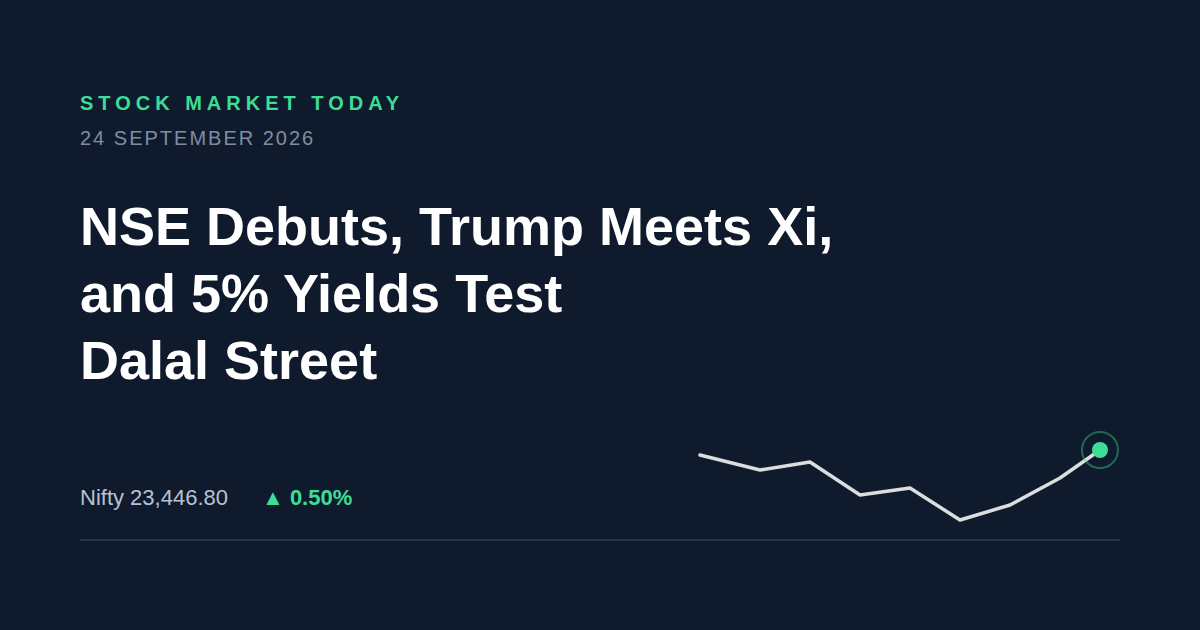
| Nifty 50 | 23,446.80 | +117.80 (+0.50%) |
| Nifty Midcap 100 | +0.69% | |
| Nifty Smallcap 100 | +0.88% |
The bounce made up for Tuesday’s fall, when the Nifty ended a four-day winning streak by closing at 23,329. Midcaps and smallcaps beat the benchmarks, which suggests investors were still willing to take risks despite the global noise.
Metals led with a 2% gain. IT lagged, down about 1%, as nervousness about US tech carried over to Indian software stocks. Liquor makers such as United Spirits, Radico Khaitan and United Breweries helped lift FMCG.
Why Indian Stocks Rose Yesterday
Two pieces of domestic news did most of the work.
First, India’s September flash PMI came in stronger than expected. It pointed to steady activity in manufacturing and services at a time when many investors worried that high oil prices would slow growth.
Second, the Asian Development Bank raised its FY27 growth forecast for India to 7% from 6.6%, pointing to a strong first quarter. That doesn’t change anything tomorrow, but it supports the idea that India’s economy can cope with the current pressure from outside.
Oil also helped a little. Brent fell for a sixth straight session and dropped below $100 a barrel for the first time since early September, trading around $98 to $99. For India, which imports most of its crude, every dollar off oil prices makes a difference.
The Big Event: NSE Makes Its Market Debut
For many investors, today’s biggest story is the listing of the National Stock Exchange, which lists on the BSE at 10 AM.
Here are the key numbers:
- Price band: ₹1,700 to ₹1,785 per share
- Issue size: About ₹22,562 crore, making it India’s second-largest IPO after Hyundai Motor India’s ₹27,870 crore issue in 2024
- Structure: Entirely an offer for sale (OFS). NSE raises no fresh money, and the proceeds go to selling shareholders such as SBI, Canada Pension Plan Investment Board, New India Assurance, GIC and Bank of Baroda
- Valuation: Up to about ₹4.42 lakh crore at the top of the band
- Subscription: 5.71 times overall. Qualified institutional buyers bid 12.68 times, non-institutional investors 6.55 times and retail investors 1.39 times
The subscription pattern tells you something. Institutions were very keen, while retail demand was modest. That fits a large, fully priced issue where big funds see a long-term holding and individual investors are less sure of quick listing gains.
Grey market indicators pointed to a small listing premium, with one widely quoted figure at about ₹42 a share, or roughly 2.4% above the upper band. Grey market premiums are unofficial and often change on listing day, so don’t treat them as a forecast.
Why it matters beyond the listing: NSE runs almost all of India’s equity derivatives trading. Its results depend on trading volumes, F&O activity and SEBI rules. Once listed, its share price becomes a public measure of how investors feel about India’s capital markets overall. A weak debut would not change the business, but it could affect sentiment for other large IPOs in the pipeline.
It’s also a crowded week for IPOs in general, with about 20 issues opening across the mainboard and SME segments and 14 companies listing.
Global Cues: Wall Street Slipped as Yields Hit 5%
Indian markets will open after a weak night in the US.
On Wednesday, the S&P 500 fell about 0.54%, the Nasdaq 1.05%, the Russell 2000 1.20% and the Dow 0.22%, based on live coverage during the session. Final closing figures may be slightly different.
Bond yields were the main reason. The US 5-year Treasury yield touched 5% for the first time since 2007, and the 10-year yield stayed just under 5%. When safe government bonds pay this much, stocks look less attractive, especially growth and tech stocks whose value depends on future profits.
This matters for India in two ways:
- IT stocks. Weakness on the Nasdaq usually spills into Infosys, TCS, HCLTech and similar names, and IT was already the worst sector yesterday.
- Foreign money. High US yields make it harder for emerging markets like India to hold on to foreign portfolio investment.
Trump Hosts Xi: Why Indian Investors Should Care
Chinese President Xi Jinping’s state visit to Washington, his first in 11 years, is expected to cover trade, AI and energy. Any sign of a US-China trade thaw could lift global risk appetite and metal prices, which would help Indian metal stocks after yesterday’s 2% rally.
A US-China deal could also cut both ways for India. Some of the “China plus one” investment case rests on continued tension between the two countries. A sharp improvement in relations could lead global investors to rethink where they put money in Asia. That is a longer-term question, but headlines from the meeting may move sentiment during the session.
US-Iran talks at the UN General Assembly are another thing to watch. President Trump described a recent meeting as “very good,” but his speeches have swung between talks and threats. Anything that affects Middle East supply will show up quickly in crude prices.
The Bigger Picture: A Market Under Pressure
Wednesday’s gain came within a longer downtrend. Before this week, the Nifty had fallen for six straight weeks and was more than 6% below its August highs.
The pressure comes from a few places:
- Foreign selling. Foreign institutional investors have sold about ₹14,941 crore of Indian equities so far in September.
- A weak rupee. The rupee has been trading near 95.9 to the dollar, which raises import costs and cuts dollar returns for foreign investors.
- Oil. Brent spent most of September above $100 before its latest fall.
- Geopolitics. US-Iran tensions, the Russia-Ukraine conflict and the threat of US tariffs on buyers of Russian energy are all in play.
Domestic investors have been the counterweight. DIIs have bought about ₹36,219 crore in September, supported by steady SIP flows from Indian households. That domestic buying is the main reason the fall has been gradual and not a crash.
Levels and Sectors to Watch Today
Technical analysts tracking the Nifty have pointed to 23,000 as a key support level and 23,600 to 23,700 as resistance. Wednesday’s close of 23,447 is roughly in the middle of that range. A decisive move above 23,600 would be the first sign that the six-week slide is ending. A fall below 23,000 would bring more downside into view.
Sectors likely to be in focus:
- IT: Likely under pressure after the Nasdaq fall.
- Metals: May extend gains if the Trump-Xi talks sound positive.
- Oil marketing companies and paints: Should benefit if Brent stays below $100.
- Capital market stocks: BSE, CDSL, brokers and AMCs may react to how the NSE listing goes.
- Banks: Will track foreign flows and bond yields.
GIFT Nifty in the early morning will give the first clear hint of where the Nifty opens.
What This Means for Everyday Investors
Days like this, with a big listing, a summit and bond yields at multi-year highs, bring a lot of headlines and a lot of pressure to act. A few principles help:
Don’t chase the NSE listing blindly. If you got an allotment, decide based on your long-term view of the business, not the first 15 minutes of trading. If you didn’t, there’s no rush. Large listings often settle down over a few weeks.
Keep SIPs running. Regular investing is built for choppy phases like this one. Stopping SIPs during a correction usually means missing the recovery.
Watch your concentration in rate-sensitive stocks. If most of your portfolio is in IT or high-valuation growth names, a period of 5% US yields can be painful. This is a good time to check that your allocation still suits your goals.
Treat daily moves as noise unless your plans have changed. A 0.5% gain or loss in one session tells you very little about where the market will be in five years.
Key Takeaways
- Sensex and Nifty rose about 0.4% to 0.5% on Wednesday, helped by strong PMI data and an upgrade to India’s growth forecast.
- NSE lists on the BSE at 10 AM today after a ₹22,562 crore IPO that was subscribed 5.71 times.
- Wall Street fell overnight as the US 5-year yield hit 5%, which could weigh on Indian IT stocks.
- The Trump-Xi meeting and US-Iran developments could move crude and metal prices during the day.
- Foreign investors are still net sellers, while domestic buying continues to support the market.
Frequently Asked Questions
What time does the NSE share list today?
A. NSE shares list on the BSE at 10 AM on Thursday, September 24, 2026, after the pre-open session.
Why is the NSE listing on BSE and not on its own exchange?
A. Market rules stop an exchange from listing its own shares on its own platform, to avoid conflicts of interest. So NSE lists on its rival, the BSE.
Why do US bond yields affect Indian stocks?
A. When US government bonds pay high, low-risk returns, global investors have less reason to put money into riskier markets like India. That can lead to foreign selling and a weaker rupee.
What is the Nifty’s key support level right now?
A. Many analysts see 23,000 as important support and 23,600 to 23,700 as resistance. These are technical views, not guarantees.
This article is for information only and is not investment advice. Market data is from closing reports and live coverage as of Wednesday, September 23, 2026. Please speak to a SEBI-registered adviser before making invest