
Most people know the Indian stock market “opens at 9:15 and closes at 3:30.” That’s still roughly true, but it leaves out most of what happens before and after those times. In 2026 it’s also no longer the whole story.
Two big changes took effect this year. From 3 August 2026, NSE and BSE introduced a Closing Auction Session (CAS) for stocks that trade in F&O, and extended F&O trading to 3:40 PM. From 7 September 2026, NSE also tightened the pre-open session rules for market orders.
This guide explains every session of the trading day, what you can and can’t do in each, and how the new rules affect your orders.
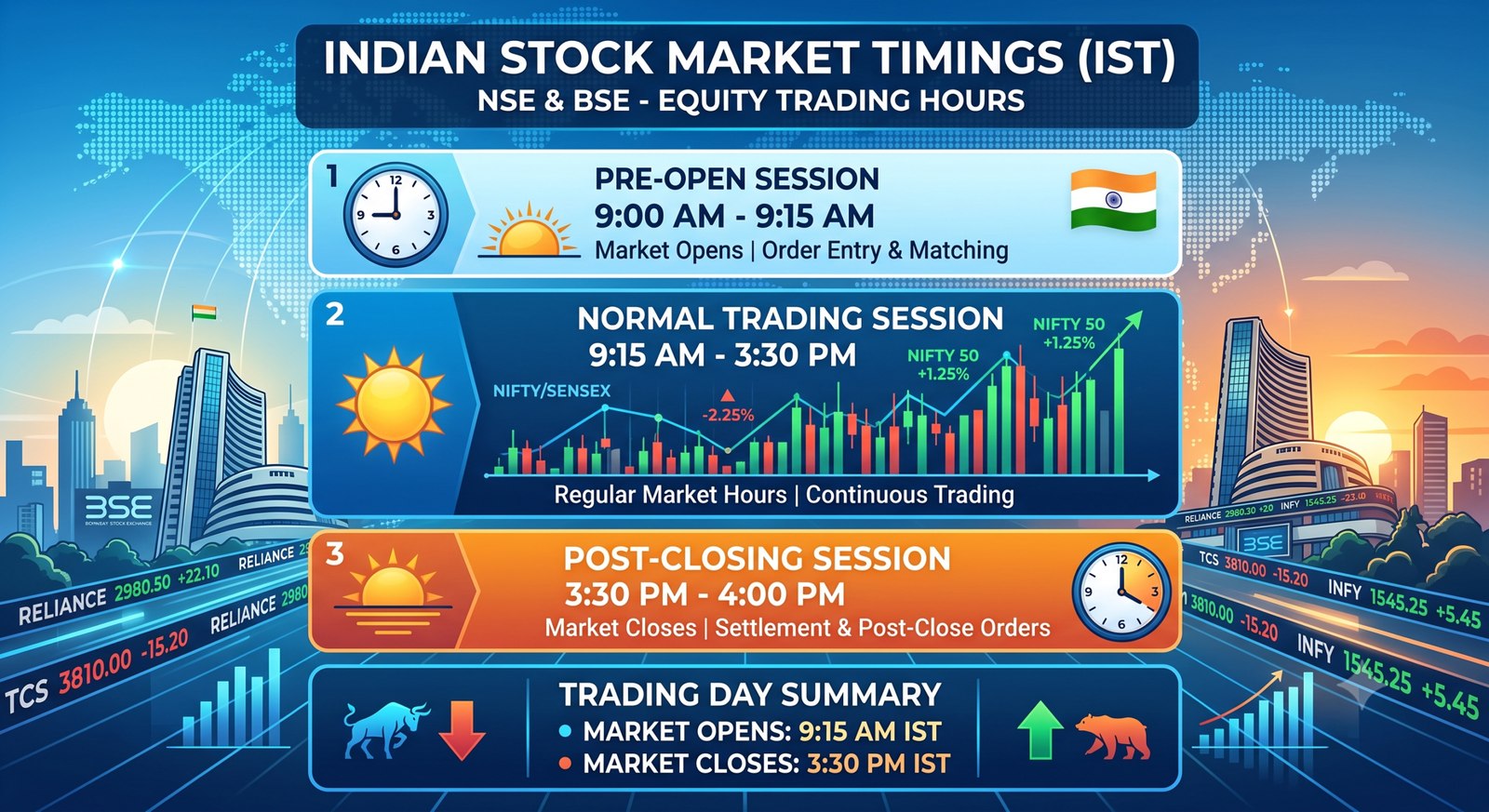
The short answer: Indian stock markets (NSE and BSE) are open Monday to Friday, except on exchange holidays. The pre-open session runs from 9:00 to 9:15 AM and normal trading begins at 9:15 AM. Stocks without F&O trade until 3:30 PM. F&O stocks switch to a closing auction at 3:15 PM, and F&O contracts trade until 3:40 PM. A post-close session runs from 3:50 to 4:00 PM, where trades happen at the closing price.
Stock Market Timings in India at a Glance (Equity Cash Segment)
| Session | Time (IST) | What Happens |
|---|---|---|
| Block deal window (morning) | 8:45 to 9:00 AM | Large block trades between institutions |
| Pre-open session | 9:00 to 9:15 AM | Orders collected and opening price discovered |
| Normal market (continuous trading) | 9:15 AM to 3:30 PM | Regular buying and selling |
| Block deal window (afternoon) | 2:05 to 2:20 PM | Second window for block trades |
| Closing Auction Session (F&O stocks only) | 3:15 to 3:35 PM | Closing price found through an auction |
| Post-close session | 3:50 to 4:00 PM | Trades only at the official closing price |
The markets are closed on Saturdays, Sundays, and the trading holidays that NSE and BSE announce at the start of each year. The exchanges sometimes hold special sessions, such as Muhurat trading on Diwali or mock trading sessions on weekends.
Pre-Open Session: 9:00 AM to 9:15 AM
The pre-open session exists for one reason: to find a fair opening price.
Overnight, a lot can happen. Global markets move, companies announce results, and policy news breaks. If trading simply started at 9:15 AM, the first few minutes could be chaotic, with prices jumping wildly on a handful of orders. The pre-open session prevents this by collecting orders first and then finding one price at which the most shares can change hands.
This method is called a call auction. Instead of matching each order as it arrives, the exchange gathers everything and calculates an equilibrium price, which becomes the stock’s opening price.
How the Pre-Open Session Works (From 7 September 2026)
NSE revised its pre-open timetable from 7 September 2026. It now works in stages:
| Time | What You Can Do |
|---|---|
| 9:00 to 9:05 AM | Place, modify, or cancel both market and limit orders |
| 9:05 AM to random close | Limit orders only. Existing market orders are locked, and new market orders are rejected |
| Random close (between 9:08 and 9:10 AM) | Order entry stops at a random moment chosen by the system |
| Random close to 9:12 AM | Orders are matched and the opening price is set |
| 9:12 to 9:15 AM | Buffer period to move into normal trading |
The random close stops traders from placing large, last-second orders just to push the opening price in one direction. No one knows exactly when the window will shut, so gaming the price is harder.
The main practical change for retail investors is the 9:05 AM cutoff for market orders. If you want to buy or sell at market price in the pre-open, place the order in the first five minutes. After that, only limit orders are accepted.
What Happens to Unmatched Orders?
If your pre-open limit order doesn’t get matched at the equilibrium price, it isn’t wasted. It moves into the normal market session at 9:15 AM at your limit price. Trades that do get executed in the pre-open are final.
Which Securities Are Covered?
The pre-open session covers equity shares, including SME stocks, REITs, and InvITs. Since 8 December 2025, NSE has also run a pre-open session for current-month stock and index futures. Near expiry, it extends to next-month futures too. Options are not included.
Normal Market Session: 9:15 AM to 3:30 PM
This is the main trading session, when most investors buy and sell. Orders are matched continuously, based on price and then time. The best-priced order gets filled first, and if two orders share a price, the earlier one wins.
During this session you can:
- Place market, limit, and stop-loss orders
- Trade for delivery (holding shares in your demat account) or intraday
- Modify or cancel pending orders at any time
Circuit limits (price bands) apply throughout the session. If a stock hits its upper or lower price band, trading in it can slow down or stop at that level. Index-wide circuit breakers can also halt the whole market if the Nifty or Sensex falls or rises sharply.
How the End of the Day Works Now Depends on the Stock
From 3 August 2026, the market splits stocks into two groups at the end of the day.
Stocks without F&O contracts: Nothing changes. Continuous trading runs until 3:30 PM. The closing price is calculated the usual way, as the volume-weighted average price (VWAP) of the last 30 minutes of trading.
Stocks with F&O contracts: Continuous trading ends at 3:15 PM. These stocks then move into the Closing Auction Session.
This covers some of the biggest and most actively traded names in the market, including most Nifty 50 stocks. Check whether a stock has F&O contracts before you plan a late-afternoon trade in it.
Closing Auction Session (CAS): 3:15 PM to 3:35 PM
The Closing Auction Session is the biggest change to Indian market timings in years. It works much like the pre-open session, but at the end of the day. Instead of averaging prices across the last half hour, the exchange runs an auction to find the closing price.
Why does that matter? The closing price is used to value mutual funds, index funds, and ETFs, and to settle F&O contracts. A price found through an auction, where many buyers and sellers meet at one point, is harder to manipulate than an average of trades.
CAS Timetable
| Time | Stage | What Happens |
|---|---|---|
| 3:15 to 3:20 PM | Reference price and transition | A reference price is set from the VWAP of 3:00 to 3:15 PM. No new orders |
| 3:20 to 3:25 PM | Order entry I | Market and limit orders can be placed, modified, or cancelled |
| 3:25 to 3:30 PM | Order entry II | Limit orders only. Random close between 3:28 and 3:30 PM |
| 3:30 to 3:35 PM | Matching | Equilibrium price found, and all matched orders execute at that price |
The equilibrium price becomes the stock’s official closing price.
What CAS Means for Your Orders
- Pending stop-loss orders in CAS stocks may be cancelled when continuous trading ends. Check your order book after 3:15 PM.
- Auction orders must fall within a price band around the reference price. Orders outside it are cancelled.
- Market orders are only allowed from 3:20 to 3:25 PM.
- Intraday auto square-off times have moved earlier at many brokers for F&O stocks, often to around 3:05 PM. Each broker sets its own cutoff, so check yours.
Post-Close Session: 3:50 PM to 4:00 PM
The post-close session lets you buy or sell shares at the day’s official closing price. You can’t choose a different price. Whatever you trade goes through at the closing price.
It’s useful when:
- You missed the close but want the day’s closing price
- You’re an investor who prefers a known price over chasing intraday moves
- You want to rebalance a portfolio at the same price used to value funds
Liquidity in this session is usually thin. There’s no guarantee your order will find a counterparty, and any unmatched orders are cancelled at the end.
In the new structure, the time between the CAS ending at 3:35 PM and the post-close session starting at 3:50 PM is a transition period. No trading happens in that window.
F&O Market Timings: 9:15 AM to 3:40 PM
Futures and options on NSE and BSE now trade from 9:15 AM to 3:40 PM. From 3 August 2026, closing time moved 10 minutes later, from 3:30 PM.
Why the extra time? F&O stocks now get their closing price at around 3:35 PM, after the auction. The extension gives derivative traders a few minutes to adjust their positions after that price is known.
A few other points for F&O traders:
- The pre-open session (9:00 to 9:15 AM) applies to current-month futures, not options.
- Contracts settle using the underlying stock’s CAS closing price.
- Trade modification requests are accepted until 4:15 PM.
Other Market Segments and Their Timings
Equity isn’t the only thing traded in India. Here’s how the other main segments compare.
| Segment | Trading Hours (IST) |
|---|---|
| Equity cash (non-F&O stocks) | 9:15 AM to 3:30 PM |
| Equity cash (F&O stocks) | 9:15 AM to 3:15 PM, then CAS until 3:35 PM |
| Equity derivatives (F&O) | 9:15 AM to 3:40 PM |
| Currency derivatives | 9:00 AM to 5:00 PM |
| Commodity (MCX), non-agricultural | 9:00 AM to 11:30 PM or 11:55 PM |
| Commodity (MCX), select agricultural | 9:00 AM to 9:00 PM |
| Commodity (MCX), other agricultural | 9:00 AM to 5:00 PM |
MCX closes at different times for non-agricultural contracts like gold, silver, and crude oil depending on daylight saving time in the US. The later closing time usually runs from November to March, because US markets open later in IST during those months.
Block Deal Windows
Block deals are large trades, usually between institutions. They happen in two separate windows so they don’t disrupt normal trading:
- Morning window: 8:45 to 9:00 AM
- Afternoon window: 2:05 to 2:20 PM
Retail investors don’t take part directly, but block deal news often moves a stock’s price later in the day.
After Market Orders (AMO)
If you can’t trade during market hours, most brokers let you place an After Market Order. You place it after the market closes or before it opens, and the broker sends it to the exchange when the next session begins.
AMO windows differ by broker. Many accept AMOs from late afternoon until early the next morning. AMOs placed for the equity segment usually go into the pre-open session or the start of normal trading. If you use market orders as AMOs, keep the new 9:05 AM pre-open cutoff in mind and confirm how your broker handles them.
Muhurat Trading and Special Sessions
Every year on Diwali, NSE and BSE hold a short Muhurat trading session, usually about an hour in the evening. It’s considered an auspicious time to start new investments. The exact timing is announced by the exchanges a few weeks before Diwali, so check their circulars.
Exchanges also hold occasional mock trading sessions, often on Saturdays, to test systems. Trades in mock sessions aren’t real and don’t settle.
Stock Market Holidays
NSE and BSE publish their trading holiday list for the coming calendar year in December. Holidays usually include Republic Day, Holi, Good Friday, Independence Day, Gandhi Jayanti, Diwali (Laxmi Pujan), and Christmas, among others.
If a holiday falls on a weekend, the market doesn’t get an extra day off on a weekday. Check the official holiday list before planning trades around long weekends.
Tips for Trading Around Market Timings
- Avoid market orders in the first few minutes unless you’re comfortable with volatility. Prices can move sharply right after 9:15 AM.
- Place pre-open market orders before 9:05 AM if that’s your plan. After that, use limit orders.
- Know whether your stock is in F&O. It changes when continuous trading ends (3:15 PM or 3:30 PM) and how the closing price is set.
- Check your broker’s square-off time. Intraday positions in F&O stocks may be squared off earlier than before.
- Use the post-close session carefully. It’s convenient for getting the closing price, but orders may not fill.
- Don’t assume old rules still apply. Articles and videos from before August 2026 may show outdated timings.
Frequently Asked Questions
What are stock market timings in India?
A. NSE and BSE are open Monday to Friday. The pre-open session runs from 9:00 to 9:15 AM, and normal trading runs from 9:15 AM to 3:30 PM for most stocks. F&O stocks move into a closing auction from 3:15 to 3:35 PM, and F&O contracts trade until 3:40 PM.
What is the pre-open session in the stock market?
A. It’s a 15-minute session before normal trading where the exchange collects orders and finds a fair opening price through a call auction. From 7 September 2026, market orders are accepted only until 9:05 AM.
What is the Closing Auction Session?
A. The CAS is a 20-minute auction from 3:15 to 3:35 PM for stocks that have F&O contracts. It sets the official closing price through an auction rather than an average of the last 30 minutes of trading. It started on 3 August 2026.
Can I trade after 3:30 PM in India?
A. Yes, in some ways. F&O contracts trade until 3:40 PM. You can buy or sell shares at the closing price in the post-close session from 3:50 to 4:00 PM. You can also place After Market Orders through your broker for the next trading day. Currency and commodity markets stay open later.
Is the stock market open on Saturday?
A. No. Indian stock markets are closed on Saturdays and Sundays, apart from rare special sessions such as mock trading or a special session announced by the exchanges.
Are NSE and BSE timings the same?
A. Yes. NSE and BSE follow the same trading hours for equity and derivatives, including the Closing Auction Session.
Understanding the Trading Day
Stock market timings in India used to be simple to remember. The 2026 changes add more steps, but the logic is clear. The pre-open session sets a fair opening price. The normal session handles regular trading. The closing auction sets a fair closing price for the most actively traded stocks. And the post-close session gives investors one last chance to trade at that price.
If you only take one thing from this guide, check whether a stock trades in F&O before you trade late in the day. That single detail now decides when its trading stops and how its closing price is set.