

The share market is a regulated marketplace where people buy and sell small pieces of ownership in companies. Each piece is called a share. When you buy one share of a company like Infosys or HDFC Bank, you become a part-owner of that business, however small your stake.
In India, this buying and selling happens mainly on two stock exchanges: the National Stock Exchange (NSE) and the Bombay Stock Exchange (BSE). The Securities and Exchange Board of India (SEBI) watches over the whole system to keep it fair.
If you have ever heard someone say “the market is up today” and wondered what that means, this guide is for you. We will cover how the share market works, the terms you will hear most often, the real risks involved, and the exact steps to place your first order.
How the Share Market Works in India
Think of the share market like a very large, very organised bazaar. Sellers want the highest price for their shares, buyers want the lowest, and the exchange matches them electronically in a fraction of a second. The price you see on your screen is simply the last price at which a buyer and seller agreed.
Prices move because demand changes. If a company posts strong quarterly results, more people want its shares and the price rises. If it loses a major contract, sellers outnumber buyers and the price falls. Broader events, such as interest rate changes by the RBI, global markets, or government policy, also push prices up or down.
Primary market vs secondary market
The share market has two parts, and beginners often mix them up.
- Primary market: This is where a company sells new shares to the public for the first time, usually through an Initial Public Offering (IPO). Your money goes directly to the company, which uses it to grow, pay off debt, or expand.
- Secondary market: Once shares are listed, investors trade them among themselves on the NSE or BSE. When you buy shares of Tata Motors through your trading app, you are buying from another investor, not from Tata Motors.
Most everyday trading happens in the secondary market.
The key players
Several institutions work together every time you buy a share:
- Stock exchanges (NSE and BSE): The platforms where orders are matched. BSE, founded in 1875, is Asia’s oldest exchange. NSE started trading in 1994 and handles the majority of equity volumes today.
- SEBI: The market regulator. It sets the rules, protects investors, and acts against fraud and insider trading.
- Stockbrokers: SEBI-registered firms such as Zerodha, Groww, Upstox, or ICICI Direct. You cannot trade on an exchange directly, so a broker places orders on your behalf.
- Depositories (NSDL and CDSL): These hold your shares in electronic form, much like a bank holds your money.
- Clearing corporations: They make sure the buyer gets the shares and the seller gets the money.
Trading hours and settlement
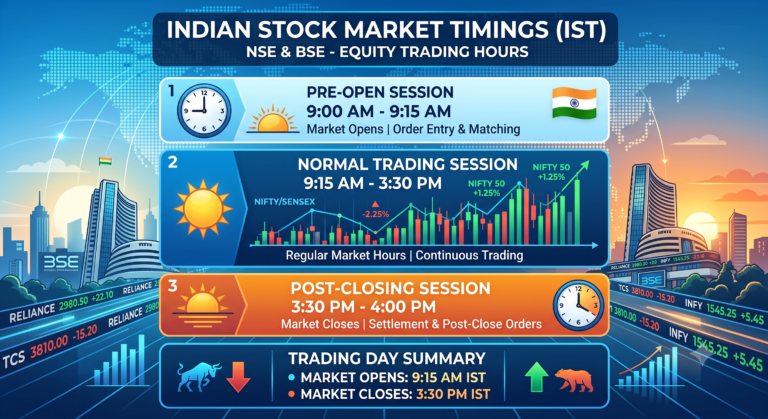
The Indian equity market is open Monday to Friday, from 9:15 am to 3:30 pm IST, with a pre-open session from 9:00 am to 9:15 am. It stays closed on weekends and exchange holidays.
India follows a T+1 settlement cycle. If you buy shares on Monday (trade day, or “T”), they reach your demat account on Tuesday. India was one of the first major markets to move to T+1 for all stocks.
Share Market Terms Every Beginner Should Know
Financial news can feel like a different language. These are the words you will run into most often.
| Term | What it means |
|---|---|
| Share (or stock, equity) | A unit of ownership in a company |
| Sensex | BSE’s benchmark index, tracking 30 large, well-established companies |
| Nifty 50 | NSE’s benchmark index, tracking 50 large companies across sectors |
| IPO | Initial Public Offering, when a company first sells shares to the public |
| Demat account | An account that holds your shares electronically |
| Trading account | The account you use to place buy and sell orders |
| Dividend | A portion of profit a company pays to its shareholders |
| Market capitalisation | Share price multiplied by total shares, a measure of company size |
| Bull market | A period when prices are rising broadly |
| Bear market | A period when prices are falling broadly |
| Portfolio | The full collection of investments you own |
What Sensex and Nifty actually tell you
When a news anchor says “Sensex fell 500 points,” they are describing the combined movement of 30 large companies, not the entire market. Indices work like a thermometer. They give you a quick read on market mood without checking thousands of individual stocks.
Many long-term investors also buy funds that simply copy these indices. That is one of the easiest ways to own a slice of India’s biggest companies in a single purchase.
Why Companies List and Why People Invest
A company goes public mainly to raise money without taking on loans. Instead of paying interest to a bank, it shares ownership with the public. Listing also brings visibility and gives early investors and employees a way to sell their stake.
For investors, the appeal comes from two sources of return:
- Capital appreciation: You buy a share at ₹500 and later sell it at ₹800. The ₹300 difference is your gain.
- Dividends: Some companies share part of their profits with shareholders, usually a few times a year.
Over long periods, equities have historically beaten fixed deposits and inflation in India. That said, past returns never guarantee future ones, and the path is rarely smooth.
The risks you should understand first
The share market can grow your money, but it can also shrink it. Being clear about this upfront will save you a lot of stress later.
- Market risk: Prices can drop sharply because of events outside any company’s control, like a global slowdown or a pandemic.
- Company risk: A single business can fail, face fraud, or lose market share. Its stock may never recover.
- Liquidity risk: Shares of very small companies may have few buyers, making them hard to sell at a fair price.
- Behavioural risk: Panic selling during a fall or chasing a hot tip during a rally causes more beginner losses than almost anything else.
A practical rule: only invest money you will not need for at least five years. Keep an emergency fund in a savings account or liquid fund before you buy your first share.
How to Start Investing in the Share Market: Step by Step
Getting started in India is quick and almost fully digital. Most people can go from sign-up to first trade within a day or two.
- Keep your documents ready. You will need a PAN card, Aadhaar linked to your mobile number, a bank account, and a cancelled cheque or bank statement.
- Choose a SEBI-registered broker. Compare brokerage fees, account opening and annual maintenance charges, app quality, and customer support. You can check any broker’s registration on the SEBI website.
- Open a demat and trading account. Most brokers open both together through online KYC, including a short video or selfie verification.
- Add money to your trading account. Transfer funds using UPI or net banking. Start with an amount you are comfortable learning with.
- Research before you buy. Look at what the company does, whether it earns steady profits, how much debt it carries, and who runs it. Annual reports and exchange filings are free on NSE and BSE websites.
- Place your order. Choose delivery (to hold the shares) rather than intraday. Use a limit order to set the maximum price you are willing to pay.
- Track and review. Check your portfolio periodically, not every hour. Review each holding once or twice a year.
A simple example
Say Priya, a 26-year-old working in Pune, opens her account and adds ₹10,000. She puts ₹5,000 into a Nifty 50 index fund and uses the rest to buy a few shares of two large companies she understands well. She sets up a monthly SIP of ₹2,000 in the index fund and resists checking prices daily. That is a sensible, low-stress start.
Different Ways to Invest in Shares
Buying individual stocks is only one option. Many beginners do better starting with pooled products.
| Option | How it works | Best for |
|---|---|---|
| Direct stocks | You pick and buy shares of individual companies | People willing to research businesses |
| Equity mutual funds | A professional manager invests your money across many stocks | Hands-off investors |
| Index funds and ETFs | Low-cost funds that copy an index like Nifty 50 or Sensex | Beginners wanting broad, cheap exposure |
| SIP (Systematic Investment Plan) | You invest a fixed amount every month in a fund | Building wealth steadily from salary |
| IPOs | You apply for shares when a company first lists | Investors comfortable with new, less-tested companies |
Intraday trading and futures and options (F&O) also exist, but they carry much higher risk. SEBI studies have repeatedly found that the large majority of individual F&O traders lose money. Beginners are wise to stay away until they have years of experience.
How Share Market Gains Are Taxed in India
Profits from selling listed shares and equity mutual funds are taxed as capital gains. The rate depends on how long you held them.
- Short-term capital gains (STCG): Shares sold within 12 months are taxed at 20%.
- Long-term capital gains (LTCG): Shares held for more than 12 months are taxed at 12.5% on gains above ₹1.25 lakh in a financial year. Gains up to ₹1.25 lakh are tax-free.
- Dividends: These are added to your income and taxed at your slab rate.
These rates have applied since July 23, 2024. Tax rules change with Union Budgets, so check the Income Tax Department’s capital gains page or a qualified tax advisor before you file.
Common Beginner Mistakes to Avoid
Most early losses come from habits, not bad luck. Watch out for these:
- Following tips from WhatsApp, Telegram, or social media. Many are pump-and-dump schemes. SEBI has repeatedly warned investors against unregistered advisors.
- Putting all your money in one stock. Spread it across companies and sectors.
- Buying because a price “looks cheap.” A ₹20 share is not cheaper than a ₹2,000 share in any meaningful sense. What matters is the value of the business.
- Selling in panic. Corrections of 10% or more happen regularly. Long-term investors who stayed put have usually recovered.
- Ignoring costs. Brokerage, securities transaction tax (STT), GST, and stamp duty add up, especially for frequent traders.
- Borrowing to invest. Leverage magnifies losses just as much as gains.
Key Takeaways
- The share market lets you buy part-ownership in companies listed on the NSE and BSE, under SEBI’s supervision.
- You need a PAN, Aadhaar, bank account, and a demat plus trading account with a SEBI-registered broker.
- Sensex and Nifty 50 are indices that show how India’s largest companies are performing.
- Index funds and SIPs are a simple, low-cost starting point for most beginners.
- Invest only long-term money, diversify, and ignore unverified tips.
Frequently Asked Questions
How much money do I need to start investing in the share market?
A. There is no fixed minimum. You can buy a single share, which may cost less than ₹100 for some companies. Many mutual fund SIPs start at ₹100 to ₹500 per month.
Is the share market safe for beginners?
A. The system is regulated and your shares are held securely in a depository. The investments themselves carry risk, though, and prices can fall. Starting with diversified index funds and a long time horizon lowers that risk considerably.
What is the difference between the share market and the stock market?
A. In everyday use, they mean the same thing. “Stock market” is sometimes used more broadly to include bonds and derivatives, but most Indians use the two terms interchangeably.
Can I invest in shares without a demat account?
A. Not directly. A demat account is required to hold shares in India. Mutual funds are the exception, since you can invest in them without one.
How do I know if a broker is genuine?
A. Check the broker’s name and registration number on SEBI’s official website. Avoid anyone who promises guaranteed or fixed returns.
Final Thoughts
The share market is not a shortcut to quick money. It is a tool for owning a piece of India’s growing businesses and letting your savings compound over time. Start small, stick with what you understand, and give your investments years rather than weeks. If you are unsure about a decision, a SEBI-registered investment advisor can help you build a plan that fits your goals.
This article is for educational purposes only and is not financial advice.